English translation by Yurri Clavilier of Bruit et lumière dans la nuit, « l’attaque fantôme » contre le Kremlin
Before dawn on May 3rd, two drones exploded while flying above the “Senate Palace” where the presidential administration is located, at the heart of the Kremlin.

These explosions, 16 minutes apart, were filmed and posted on social media right after the Kremlin issued a press release.
The images show two slow-moving drones, one arriving from the West and the other from the East, exploding in flight over the dome
Between the explosions, two firefighters visible on the video climb onto the structure, certainly to extinguish the debris from the first device which landed on the roof, but they seem « unaffected » by the second’s explosion, nor is the flag flying over the building, nor the building itself, which does not even seem damaged by these two « attacks »…
Interceptions and questions
How did these slow, inefficient drones manage to fly over the symbol of Russian power when it is probably the most protected place in all of Russia, except for Vladimir Putin’s bunker on Moscow’s outskirts?
This is either an extraordinary feat by Ukrainian forces or by the networks supporting them, or the Kremlin’s staging of the threat posed by Ukraine to Russia.
The first question arises from the type of attack perpetrated, and the second from the very interception of these drones.
Explosions with no effect on the dome
If the drones were able to reach the targeted dome, they would have had to be precipitated onto it to add kinetic damage to that caused by the explosion of their warheads. A drone, when used in kamikaze mode, rushes towards its target while in terminal phase.
However, this is not what the videos show: the drones explode in a flash of light, remaining well above target. This looks more like fireworks display than an attack, unless the « terrorists » denounced by Moscow wanted to avoid committing any damage and rather content themselves with a power move… with neither the strength nor the capacity to repeat such “show of force” as multiple precautions are inevitably taken following such an event.
So, these drones did not formally attack the Kremlin, but exploded in the skies above it, threatening it at most, between 2 and 3am, which was unlikely to cause any sort of panic.
It’s important to note, again thanks to the video, that the two explosions caused virtually no damage, whereas a 40 kg military charge, the payload of this type of drone, is the equivalent of a 155 mm artillery shell, and should have, in order, blown up part of the dome structure, shredded the mast and Russian flag above it, and severely shaken the two firemen climbing the structure.


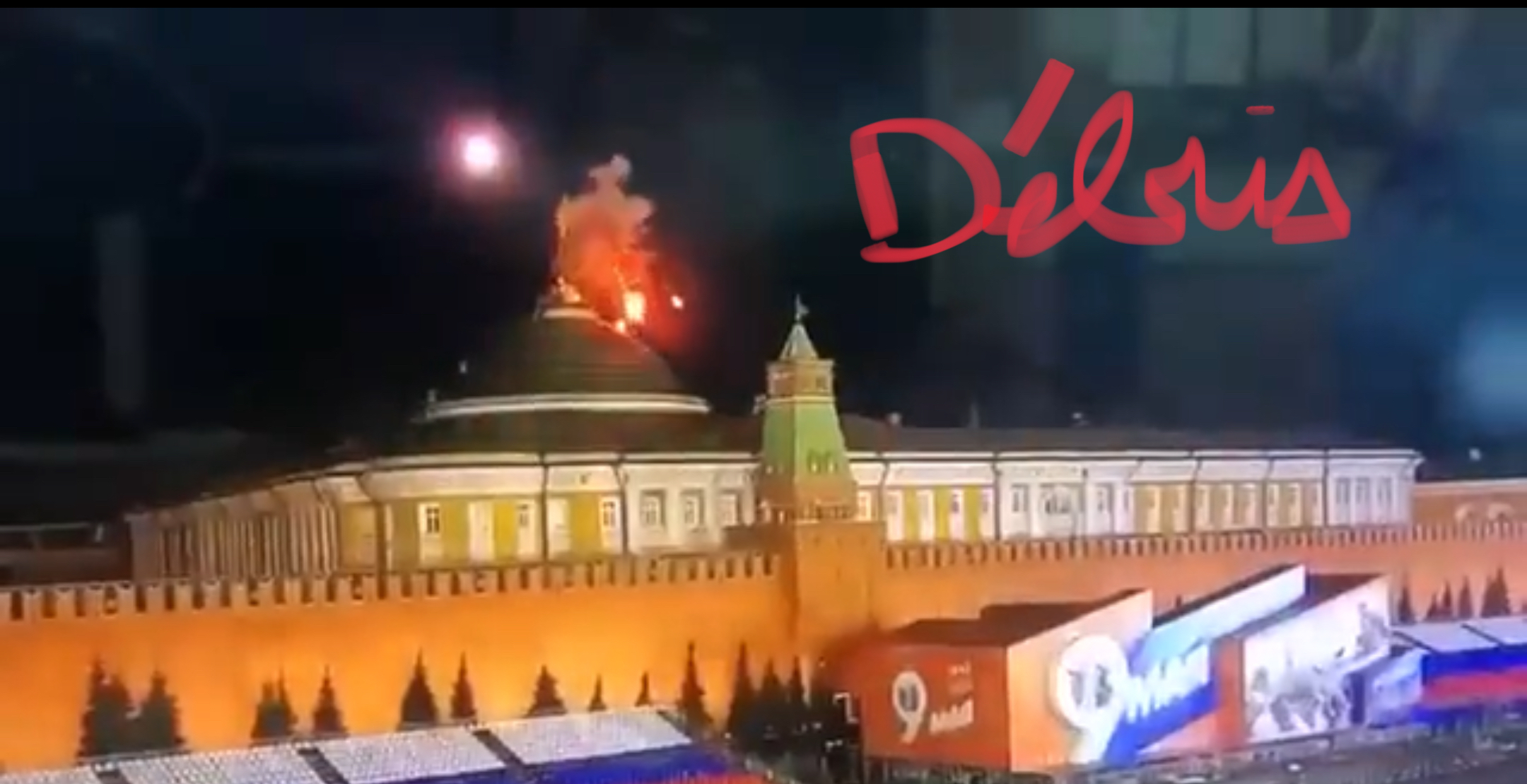

In fact, these explosions mainly produced some light and noise, unlike a warhead which destroys, explodes, and ignites…
Perhaps the Ukrainians did not want to make a mess over the Kremlin so as not to upset Vladimir Putin? Or, more likely, it was the Russian authorities who organized this « phantom » strike, without going so far as to set their own palace ablaze…
Destruction of the drones without interception
This staging by the Kremlin is even more probable as the interception of these drones is, to say the least, enigmatic. In anti-air defence, the logical choice is to intercept the threat before it reaches its objective and, above all, never let it go over it, which would be a « blatant » failure of its protection.
To achieve this, the Russian capital benefits from at least three layers or circles of defence, the first of which covers a very wide, high space into which a drone could effectively penetrate. But given the resources deployed to defend Moscow, and even more so to secure this place of power, the drones should have been intercepted in the second or third circle, at a perfectly respectable distance from the targeted dome (several km). Obviously, any video recorded of a more successful interception would have been immensely less interesting as the Kremlin, the icon of Russian power would, of course, not be visible.
The images show no trace of an interceptor, while the Russian presidency claims that « the two drones targeting the Kremlin » were « disabled by the use of radar systems »…
To date, radar systems are used to detect drones, not to « disable » them, and if it were another neutralization device – a directed-energy beam or a very high-powered laser (not necessarily visible to the naked eye) – why not destroying them before the drones even « reached » their target?
« Far from being an interception, the explosion of these two drones over the Kremlin was a spectacle ».
As a former anti-aircraft artillery officer, for me the drone explosion over the Kremlin was a « phantom strike », most likely organized by the Russian regime headed by Putin. The Russians detonated these drones over the Kremlin with a quasi-inoffensive charge designed to make some light and noise.
Meanwhile, Putin’s Russia continues to launch near-daily attacks against civilian targets in Ukraine, killing dozens, without any meaningful military objective…
A « phantom strike » for which purpose?
The context in which Putin’s government finds itself explains this staging quite well: the regime knows that it is going to be put in great difficulty by the incoming Ukrainian counter-offensive, and that it will have major difficulties in justifying this « special military operation » against Ukraine if it becomes a flagrant failure of whatever power remained of a declining country.
The Russian president needs to dramatize the situation to justify his disastrous initiative to invade a neighbouring country, and to continue to mobilize Russian society, making it believe that it is threatened by the very Ukrainians it has attacked…
As the great patriotic festival of May 9 approaches, commemorating the victory over the Nazis, whose descendants Putin accuses the Ukrainians of being, Russian power is becoming even more fragile as its current military resources enable it neither to conquer Ukraine, nor to effectively oppose a professionally conducted counter-offensive.
The statements made by Prigozhin, Wagner’s mafia boss, denouncing the lack of ammunition and threatening to withdraw from Bakhmut, which was supposed to be his great victory on the front, are part of this same understanding of the situation: Bakhmut is no longer important compared to the offensive to come (and against which the Russian army wants to keep its ammunition), and all these dead and wounded (tens of thousands) have been sacrificed for nothing, an appropriate illustration for this invasion of Ukraine by Russia. The rats are starting to flee the ship…

So, Putin is tempted by a headlong rush, accusing the United States of being behind this phantom strike that he organized himself, hoping perhaps to keep the initiative and continue to threaten a world that does not yield to his imperial delusions.
This phantom strike on the Kremlin reflects a kind of runaway enthusiasm on the part of Russian power, as if it sensed that the precipice was inexorably approaching. The fall of these drones may well foreshadow the fall of the power that organized it…
The next stage will be played out over the coming weeks, and it is not yet a foregone conclusion.
En savoir plus sur Guillaume Ancel - Ne pas subir
Abonnez-vous pour recevoir les derniers articles par e-mail.

2 commentaires sur “Some light and noise in the night, the “phantom strike” against the Kremlin”