[English translation by Yurri Clavilier of Face à son échec en Ukraine, la Russie de Poutine se fissure… et son armée désormais nous le dit published by Guillaume Ancel]

Days after days of intense fighting
Just as we are about to enjoy the summer, looking for an ephemeral serenity, every day in Ukraine sees fighting of a rare intensity. On the offensive, Ukrainian forces are attacking the dike built by Russian troops, with the aim of breaching the 30 km-wide wall and then of overwhelming Putin’s armies, who have invaded the east of their country.
And every day, too, Putin’s Russia sends bombs from the air, in the form of drones and missiles, reminding Ukrainians why they must fight: to reclaim their own territory and to win peace, to be able to live in peace, that most precious state for our society that we too often tend to forget…
A cracking Russian front: General Popov says so and is fired.
Russian major general Ivan Popov is the commander of the 58th Combined Arms Army, which is considered one of the best units engaged in Ukraine, as highlighted by the France based Think Tank la Fondation pour la recherche stratégique (the Foundation for Strategic Research or FRS) in this 2022 article [in French].
The Russian 58th CAA is fighting in the Zaporizhzhia region, at the centre of the frontline and the current epicentre of the Ukrainian assault. What General Popov describes sounds like a warning signal from the Russian side, and the fact that he is being fired rather than listened to speaks volumes about the future outcome of this battle.
Popov describes the effectiveness of Ukrainian artillery and the damages it causes, as much at the first line of contact than deeper within Russian lines, while his deputy was killed by one of the strikes that cripple the Russian army – I will come back to this later.
This Russian general believes that their own forces do not know how to sufficiently conduct counter-battery fire against the now dreaded Ukrainian artillery (counter-battery consists of destroying enemy artillery to prevent it from doing any harm), even though Russian artillery has until now been considered to outclass – at least in numbers – Ukrainian forces.
Finally, General Popov highlights the deficiencies of military intelligence, which should make these counter-battery fire possible, thanks to the spotting and tracking of Ukrainian guns and missile launchers.
« One of the most senior Russian military commander denounces the operational situation in Ukraine. »
General Popov describes a cracking Russian front and a reversal of firepower in favour of the Ukrainians. He does not do so on a whim because of emotion or for political gain, as one might suspect from Wagner’s mafia boss and his aborted attempt at armed insurrection on 24 June.
In fact, General Popov is a respected and experienced war leader. What he describes must be seen as a severe indictment of the state of his own side. The fact that one of Russia’s most senior military leaders is denouncing the operational situation in Ukraine is the very admission that this dike is being severely breached, confirming the effectiveness of the Ukrainian strategy, prepared with its allies: patiently attack this dike to make it implode.
A Russian army weakened by Ukrainian attacks and plagued by poor leadership.
The Russian high command reaction to immediately dismiss General Popov is both normal and appalling: such an affront would undermine the military command’s authority and relevance; thus, it cannot go unpunished. The Russian Chief of Staff and head of operations in Ukraine, General Gerasimov, had already been shaken by Wagner’s armed insurrection three weeks earlier. He is now being challenged by his own side, the Russian army… part of which was probably keen to side with the rebellion « led » by Prigozhin, but of which Popov was never a member.
By firing General Popov, the Russian high command exposes its weakening, and acknowledges that its authority is being questioned even within its own ranks, which are not known for their freedom of expression or for sharing their state of emotion…
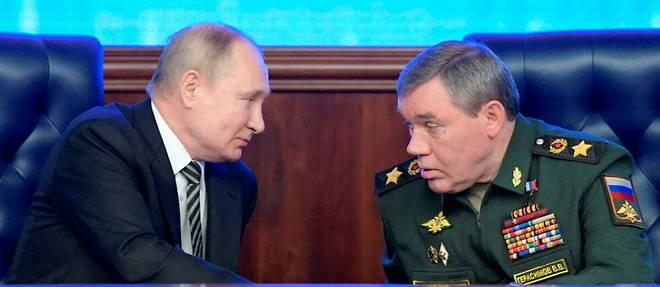
One could imagine for a moment that if a leading Ukrainian general had behaved in a similar way during the crucial phase of the offensive launched at the beginning of June and had publicly declared that this manoeuvre was futile because their means were insufficient and their command mediocre, and, if he had added that the Ukrainian forces were taking a beating from the Russians after every attempt at approaching the dike: then that would have been like a storm, calling into question the whole operation and even more so its leader…
Putin is challenged by his own army.
Yet, who is directing Russia’s war against Ukraine, if not ultimately the head of the armed forces, Vladimir Putin himself? Once again, Putin’s power and his special operation against Ukraine are questioned by General Popov’s statements as it is relayed by veterans that are members of the Duma. It is indeed a part of the Russian army which is announcing Putin’s future military failure in Ukraine.
General Popov’s warning is therefore a very encouraging sign for the Ukrainian offensive, and his immediate dismissal by the Russian high command is a confirmation that Putin’s authority is wavering once again. Yet some would have us believe that the master of the Kremlin could emerge strengthened from the crisis caused by Wagner, a mafia-like company that only existed because Putin wanted it to.
Devastating Ukrainian strikes deep within Russian occupied territory
General Popov confirmed that the Russian military forces were taking a heavy toll due to Ukraine’s deep strikes, especially its logistics and key command elements (the military staffs responsible for command and control), as the Ukrainians now have the weapons to strike beyond 100 km.
His own deputy, lieutenant general Tsokov, was killed by a Storm Shadow missile strike which destroyed his headquarters in Berdiansk. These Storm Shadow missiles are extremely destructive due to their precision, the power of their warhead (450 kg, the equivalent of 10 artillery shells at once) and the difficulty of intercepting them thanks to their « stealth » flight profile.
But only a few dozen of these Storm Shadow missiles have been delivered by Great Britain, whose stock is in the hundreds. This is undoubtedly one of the reasons why the British Defence Minister replied – annoyed – that Britain « wasn’t Amazon » when the Ukrainians asked for more.
Fortunately, France has eventually decided to deliver some of its own missiles, called the SCALP, which is the only difference with the British Storm Shadows as both are identical. These additional missiles will enable Ukrainians to continue their deep strikes, complementing those they have carried out to date within the first 100 km of the frontline.
Now, with a range of over 250 km, no major Russian target on Ukrainian territory is beyond the reach of Ukrainian strikes, provoking one of the usual Kremlin’s misleading denials against this, which confirms the importance of this delivery by France. A delivery with immediate effect, since the first examples arrived in Ukraine as soon as President Macron made his announcement.
On a side note, it is interesting to notice that the French far-right has taken on what Wagner’s troll factories have been doing until now: systematically and crudely disinforming against anything that might upset the Kremlin.
Marine Le Pen, who has been rather discreet about her support for Putin’s regime, denounced these SCALP missile deliveries, referencing the usual narrative of being “irresponsible” and that would supposedly increase the risk of escalation. Beyond the fact that it is impossible for the Russians to distinguish whether a missile of this type is British or French, it should be remembered that the only people threatened by these weapons are the invading Russian forces… This says a lot about Madame Le Pen’s continuing link to Putin’s Russia.
Russian armies are also weakened by KGB purges following Wagner’s uprising.
As if Putin’s troops were not weakened enough by their failure in Ukraine – that special operation that was only supposed to last three weeks – the Russian armies are currently undergoing a purge operation, led mainly by the KGB/FSB. Putin’s original corps, of which he was a lieutenant-colonel, the KGB/FSB is undoubtedly the security force that brought down the attempted insurrection « led » by Prigozhin (the use of quotation marks is deliberate; I doubt who was behind this mafia leader).
Thus, General Surovikin, who was no less than the commander of operations in Ukraine and a close ally of Prigozhin, is now « resting », as the Kremlin spokesman so delightfully put it. Not that he is sitting by a swimming pool, more likely on the edge of a precipice.
Similarly, at least thirty Russian military leaders are currently detained or sidelined, at the worst moment of the war in Ukraine, according to the Institute for the Study of War:
The Kremlin reportedly ordered the detention and suspension of several senior military officers following the Wagner Group’s armed rebellion on June 24, supporting ISW’s prior assessment that the Kremlin likely intends to purge the MoD of figures viewed as disloyal. The Wall Street Journal (WSJ) reported on July 13 that Russian authorities detained at least 13 senior military officers and suspended or fired around 15 senior officers following the Wagner Group’s armed rebellion on June 24. […]. The WSJ reported that one source claimed that the detentions are intended to” clean ranks” of those Russian President Vladimir Putin no longer sees as trustworthy.
Putin continues to erase Prigozhin, who, as we are belatedly realizing, was never a military leader – others oversaw « his » military operations – but a mafioso, just like his master. And the Russian army is paying dearly for its hesitancy to show its support to the master of the Kremlin when he was threatened by his own « lieutenant », as these mafia circles like to call themselves.
An international front that holds firm in the face of an ever-shrinking Russian power
NATO met at the Vilnius summit on 11-12 July, and mostly demonstrated the coherence of Ukraine’s allies and of their main military organization: there is no question « under the pressure of events, but also of emotion » of escalating this conflict by integrating a country at war into this organization intended primarily for their military defence.
Its Secretary, Jens Stoltenberg, made it clear without hesitation: the conditions are not fulfilled to let Ukraine join while the war is still raging. The country will be invited by NATO to join once the conflict over, and visibly without a « Membership Action Plan », the cumbersome process of bringing it into line with the organization’s strict standards.
Indeed, NATO is first and foremost a system to coordinate the armed forces of each of its members. In a similar way to its accession to the European Union, Ukraine will benefit from a special process that will enable it to gradually comply with these operating standards, without remaining outside the confines of these Unions, which have so far ensured peace and prosperity for their members.
Without bringing the candidate in today, the North Atlantic Treaty Organization confirmed its full support for Ukraine, and even more, for the long term. Of particular note is the « security commitment » to Ukraine of the G7, the group of seven of the world’s most powerful countries. They are all members of NATO, except for Japan, and are thus demonstrating effective support for Ukraine, well beyond this offensive.

The G7’s commitment to the NATO summit is an eminently political message: for Putin’s Russia, which had hoped that the war he unleashed on Ukraine would tear these groups apart and weaken their support as well as themselves. It is also a message for the rest of the world, as some countries had hesitated to condemn Putin’s war of aggression in the name of challenging this world order.
A lasting G7 support for Ukraine
While the Vilnius summit did not satisfy President Zelensky’s expressed impatience for Ukraine to be considered a NATO member, it did confirm the weakening of Russia’s political power: the entire G7 is united against Putin’s Russia. At the same time, NATO is getting stronger, with Finland and soon Sweden joining. And even Turkey, which Putin tried to use to bend the military alliance of which it is an important member, is openly contributing to this process of long-term support for Ukraine.
Putin’s Russia is weakening, cracking on both the military and social fronts, and even more so on the international stage. So much so, in fact, that the American president can confidently state that « Putin has already lost the war against Ukraine ».
Meanwhile, the fighting continues…
The question now is no longer whether Ukrainian forces will win this offensive, but when they will break through this dam and overwhelm Putin’s troops.
Their offensive is destined to bring about Putin’s downfall, which will no doubt be orchestrated by his own regime and will involve a period of chaos and uncertainty in Russia.
Putin’s downfall is the key to a lasting peace in Ukraine, and the allies understand this: winning this war in Ukraine is the price of peace, and chaos in Russia as Putin is replaced is a necessary step.
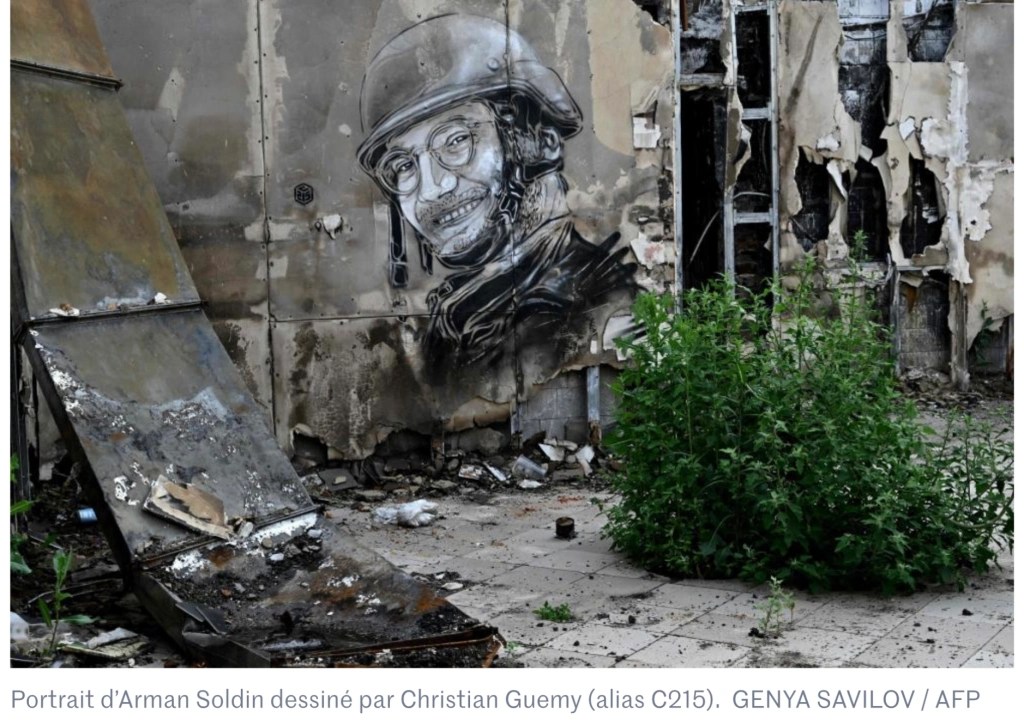
Post Scriptum: I would like to pay tribute to the French journalist, Arman Soldin, who was killed near Bakhmut last May. He reminds us how key journalists are to our society, and why their role of informing us is paramount. Their courage and professionalism honour us all.
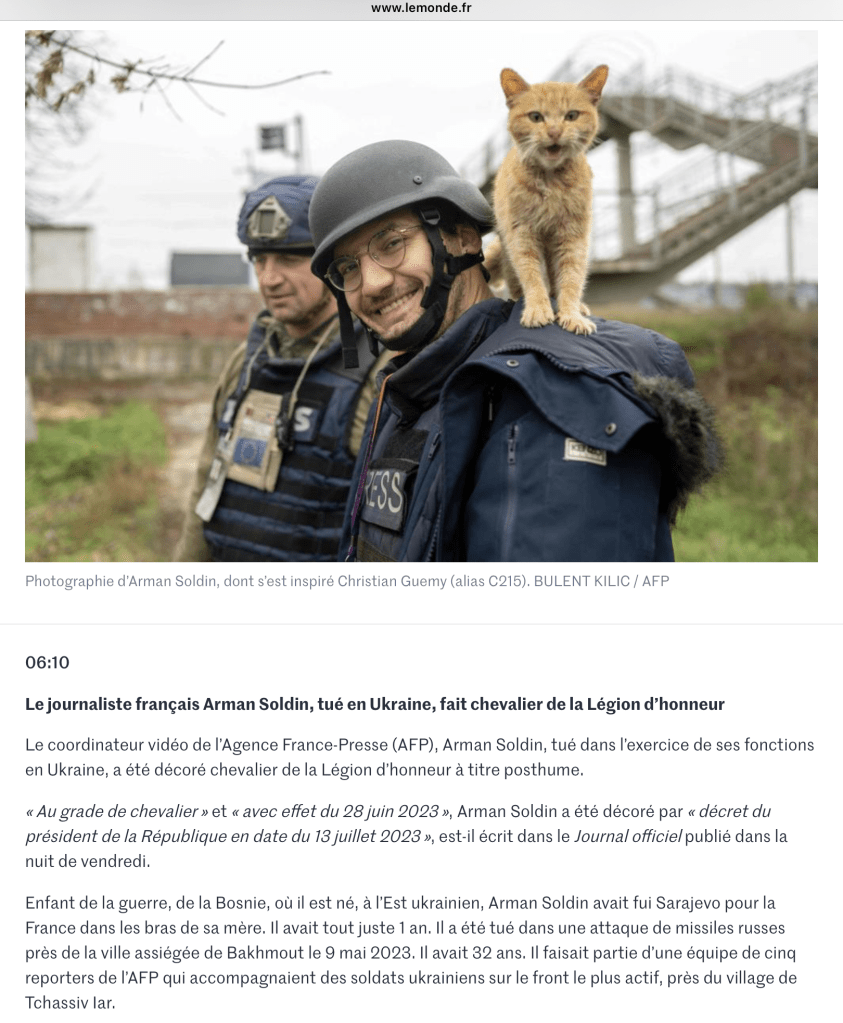
Arman Soldin, who was born in Sarajevo, also reminds me of the atrocious conflict that bloodied the Balkans for so many years and that we have not completely resolved, particularly by letting Serbia lean on Putin’s Russia to feed its hatred of others.
I recounted my involvement in Sarajevo, from the siege of the city to the massacres at Srebrenica, in this account published by Les Belles Lettres,

Vent glacial sur Sarajevo is an eye-witness account of the reality of this operation which left a mark on my generation. I took the time to tell the story of these professional soldiers, my comrades-in-arms, of their courage, of the inextricable situations, and of the besieged capital we failed to protect.
I recommend this story to anyone who wants to get a glimpse of the situation the Ukrainians have been facing for over 16 months. The behaviour of the Serbian army in Sarajevo was eerily similar to that of the Russian armies in Ukraine, which is probably why I feel I can more easily decipher this war that we were unable to prevent. Let us hope we can win it, that is the price of peace.
En savoir plus sur Guillaume Ancel - Ne pas subir
Abonnez-vous pour recevoir les derniers articles par e-mail.

Bonjour
Ces commentaires, en rajout d’une interview, sont vraiment très instructifs. Merci !
J’aimeAimé par 1 personne
Ma bien modeste contribution au site de Guillaume Ancel :
http://www.guillaume-de-lamoignon.fr/2023/08/23/ukraine-commentaires-a-propos-dune-chronique-dun-ancien-ambassadeur-de-france/
J’aimeAimé par 2 personnes